What most teams rely on today
- automation tools
- standalone agents
- scripts and integrations
- departmental software
These tools can improve productivity, but they do not provide a way to manage the business system as a whole.
AI is changing how work gets done.
Across industries, companies are beginning to deliver outcomes through AI-powered services rather than traditional software tools.
Instead of buying software and doing the work themselves, organizations are starting to run services such as:
Each service combines AI agents, human oversight, and existing systems to deliver a specific business outcome.
But as the number of AI-powered services grows, companies face a new problem: How do you coordinate them?
These tools can improve productivity, but they do not provide a way to manage the business system as a whole.
VisionList was designed to solve this problem.
VisionList allows organizations to define and operate their business as a network of services.
Each service delivers a specific outcome and is defined by:
Examples include:
Instead of scattered automation, the company now operates a coordinated service architecture.
AI agents perform much of the intelligence work required to deliver services:
Humans remain responsible for judgement, oversight, and strategic direction.
VisionList ensures agents operate within clear rules and aligned business intent.
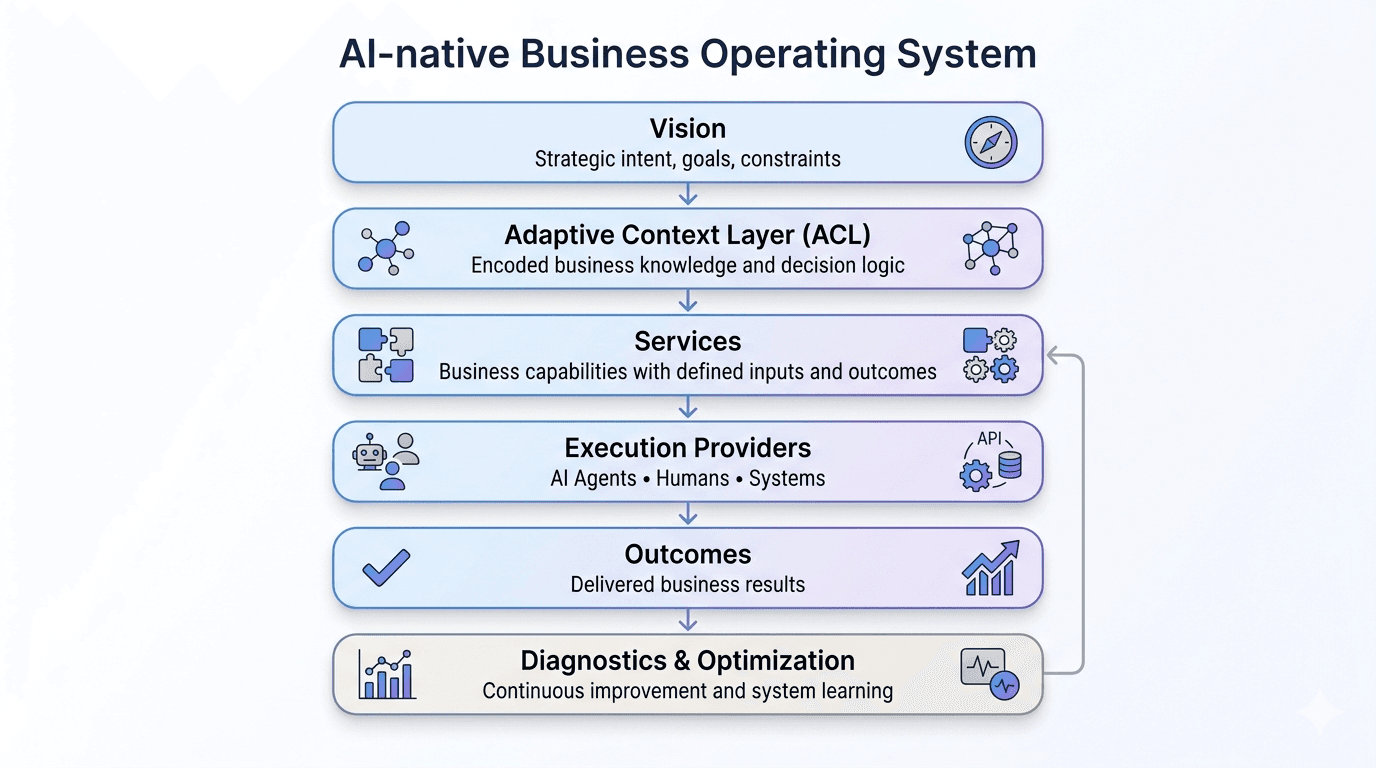
VisionList combines three layers:
The leadership team defines the strategic intent, goals, and constraints guiding the business.
The company's operational knowledge is encoded so AI systems can reason over it.
Services, agents, and systems are coordinated to deliver outcomes reliably.
Once this structure exists, the organization can run diagnostics and continuously improve the system.
AI tools improve individual productivity. AI services change how work is delivered.
VisionList enables companies to design and operate those services as a coherent system.
The result is:
Over the next decade, successful companies will not simply use AI tools.
They will operate AI-powered services across every part of the business.
VisionList is the platform that helps organizations design, govern, and run those services.
Choose where you want to go next:
Vision defines the direction. Context encodes how the business works. Services deliver outcomes through coordinated agents, systems, and people. Diagnostics continuously improve the system.
In many software systems, a workflow is simply a sequence of steps that executes once and then disappears. VisionList approaches services differently.
A service in VisionList is not just a workflow. It is a durable operating unit of the business.
Each service represents a specific capability the organization relies on to deliver outcomes. Examples might include lead qualification, customer onboarding, contract review, campaign execution, or procurement analysis.
Because these services are central to how the business operates, VisionList treats them as managed objects rather than temporary processes.
As the organization runs the service repeatedly, the system accumulates context about how that capability actually performs.
In this way, services become living operating units rather than static process diagrams.
The result is that the organization can begin to manage its operations more like a software system:
This creates a fundamentally different way of thinking about how companies operate.
Instead of relying solely on people coordinating work across departments, the business becomes a structured system of services that can be observed, improved, and scaled.
AI agents perform much of the intelligence work required to run these services, while humans retain responsibility for judgement, oversight, and strategic direction.
VisionList provides the platform that allows organizations to define, govern, and continuously improve these services as part of a coherent operating system for the business.
Over time, this service architecture becomes one of the most valuable assets a company can build.
Because once the operating logic of the business is encoded as services, it becomes possible to:
In this model, the business is no longer just a collection of departments coordinating work. It becomes a system of services that can be designed, operated, and improved intentionally.